


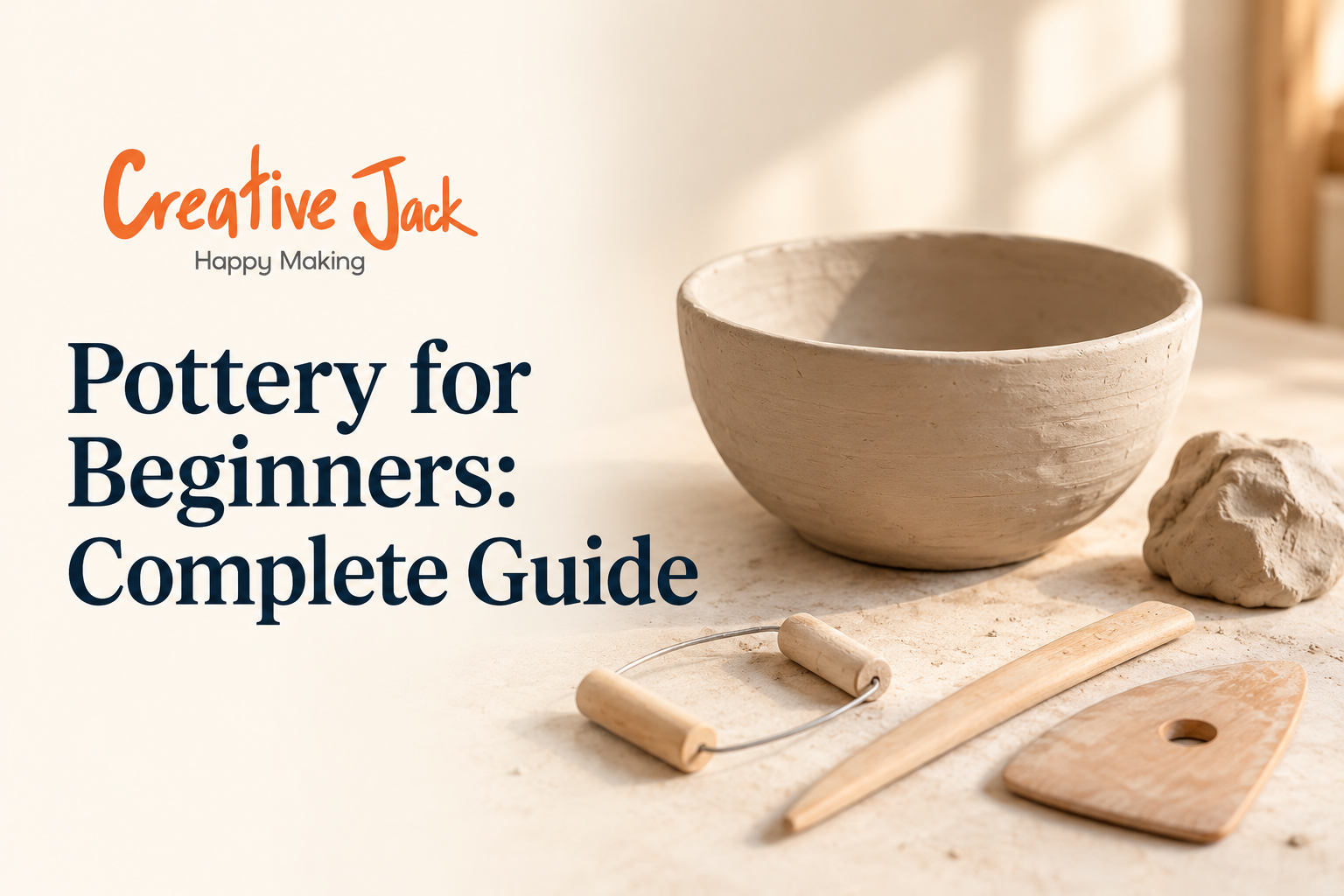
Pottery for Beginners: Complete Guide
Pottery for beginners starts with three decisions: which clay to use, which hand-building technique to learn first, and where to practise. Most people do best with air-dry or terracotta clay, a simple pinch pot, and a small class where someone can look at their work and tell them what went wrong. This guide walks through all of it, from the first lump of clay to a finished piece on your shelf.
What You'll Find in This Guide
• What pottery is, and how it differs from sculpture and ceramics
• The main types of clay, and the real difference between clay and terracotta
• A step-by-step first project you can follow
• The mistakes almost every beginner makes
• How to decide between learning at home and joining a class
Why So Many Beginners Give Up in the First Week
Pottery looks calm in videos. A person sits at a wheel, the clay rises into a perfect cylinder, and it seems easy. Then you try it yourself and the clay slumps, cracks, or sticks to everything except the thing you wanted it to stick to.
Most people who quit early are not bad at it. They just started in the wrong place. They bought the wrong clay, picked a project that was too ambitious, watched six different tutorials that contradicted each other, or made something lovely that cracked as it dried and decided clay was not for them.
None of those problems is hard to fix. They mostly come down to knowing a few basics before you begin, which is what the rest of this page is for.
What Pottery Actually Is
Pottery is the craft of making objects from clay, such as bowls, cups, plates, vases, and planters, and then hardening them so they hold their shape. Pottery and clay go together so closely that people use the words interchangeably. To create pottery, or just to understand pottery making, it helps to think of it as three stages. You shape the clay while it is soft. You let it dry. Then you harden it, either by firing it in a kiln or, with some clays, by letting it air dry completely.
People often use pottery, ceramics, and sculpture as if they mean the same thing. They overlap, but they are not identical. Pottery usually means functional or decorative vessels. Ceramics is the wider word for anything made from clay and fired, including tiles and sanitaryware. Sculpture is about form and expression, and a sculptor might use clay, stone, metal, or wire. Plenty of beginners start with pottery and drift into sculpting without noticing, because the skills are so close. If that sounds like you, our guide to hand building vs wheel pottery covers where the two meet.
Understanding Pottery Clay
Anyone searching for pottery clay will find a confusing list of names. The clay of pottery is not one single material, and clay in pottery generally falls into a few families. Browse the clay pottery section of any craft shop and it can feel like a lot, so here is the short version. Ceramic clay is the umbrella term for all of them.
Earthenware. Soft, forgiving, and fired at lower temperatures. It stays slightly porous unless it is glazed. Terracotta belongs to this family.
Stoneware. Fired at higher temperatures, which makes it strong and, once glazed, water resistant. It is the usual choice for mugs and dinner plates.
Porcelain. Fine, white, and smooth, but less forgiving. Most beginners should leave it for later.
Air-dry clay. Hardens without a kiln. It is the easiest way to begin pottery with clay at home or in a short workshop, though finished pieces are less durable and are not meant to hold food or drink.
If you want to make pots with clay for plants, terracotta is the natural pick, and it is also the best clay for pots that will hold soil, because it is porous and forgiving. Shops often group things under labels such as "pots clay" or "pots pottery", which tells you very little, so read the description for the type of clay and how it is meant to be finished. If you are looking at clay and pottery supplies for the first time, pick one clay and stay with it for a month. Switching between three kinds makes it hard to learn how any of them behaves.
Clay and Terracotta: What Is the Difference?
This is one of the most common questions we hear, and the confusion is understandable. Clay is the broad material. Terracotta is one particular kind of clay. The difference between clay and terracotta is a bit like the difference between "fruit" and "mango".
Terracotta clay is earthenware, usually reddish brown because of the iron in it. When people say terracotta pottery, they usually mean unglazed or lightly finished pieces such as plant pots, diyas, tiles, and small figurines. Terra cotta pottery is simply an alternate spelling of the same thing, and you will see both.
A few things to know about terracotta material:
• It is porous, so unglazed pieces absorb water. That is perfect for plant pots and not great for a water jug.
• It handles well, which is why it is such a common choice for clay and terracotta projects in beginner classes. Terracotta clay pottery is also a familiar sight in Indian homes, from planters to diyas.
• Terracotta work rewards simple, chunky shapes and visible texture, so it suits beginners who are not ready for fine detail.
• It comes in both kiln-fired and air-dry versions. Terracotta clay air dry products let you finish a piece without a kiln, which suits home practice.
• Many terracotta clays are also sold as terra cotta clay for pottery and as terracotta clay for sculpting, depending on how smooth the clay body is.
If you want to try working with terracotta, start with a small planter or a coil bowl. The colour is warm, the clay is forgiving, and flaws look charming rather than wrong. Terracotta art has a long history in India, in everything from village pots to temple figures, so you will have plenty of inspiration around you.
Basic Clay and Beginner Clay
When a shop sells "basic clay" or "beginner clay", it generally means a soft, smooth clay that is easy to knead and does not dry too fast. For a first project, that is exactly what you want. You can graduate to coarser, grittier clays later, which hold their shape better on larger pieces.
Step-by-Step: Your First Pottery Project
A pinch pot is the best first project in pottery. It teaches you how clay feels, how thick a wall should be, and how smoothing works, and it needs no tools beyond your hands. Here is how to do it, with the reasoning behind each step.
Step 1: Prepare the clay. Take a piece about the size of a tangerine. Squeeze and fold it in your hands for a minute or two. Potters call this wedging when they do it on a table with more force. It removes trapped air and makes the clay even, which matters because air bubbles can crack a piece as it dries or fires.
Step 2: Roll it into a ball. Smooth it between your palms until there are no creases on the surface.
Step 3: Open the ball. Push your thumb into the middle, stopping about a centimetre from the bottom. Rotate the ball and pinch gently between your thumb and fingers, working from the bottom upward, so the walls thin out evenly.
Step 4: Even out the walls. Check as you go. Walls that are too thin collapse, and walls that are too thick can crack while drying. Aim for roughly the thickness of your little finger at the start and thinner as you gain confidence.
Step 5: Smooth and shape. Use a damp finger or a small sponge to soften fingerprints. Tap the base gently on a flat surface so the bowl sits level.
Step 6: Add detail. Texture the outside with a fork, a leaf, or a stamp. This is where your piece starts to look like yours.
Step 7: Dry it slowly. Keep it out of direct sunlight and away from a fan. Uneven drying causes cracks. Cover it loosely with plastic for the first day if the weather is hot, then let it dry on a shelf.
Step 8: Finish it. With air-dry clay, you can sand, paint, and seal the piece once it is fully dry. With kiln clay, the piece is fired in a kiln, then glazed if you want a glossy finish. If you are not sure which clay you have, check the packaging before you decide how to finish.
Once you are comfortable, step-by-step pottery projects can go further: coil pots, slab trays, and small plates. Our post on beginner pottery projects gives you ten to try in order.
The Core Pottery Techniques
Beginners tend to hear about pottery techniques in a jumble, so here they are in plain terms.
Pinch. You shape the clay with your fingers, as in the project above.
Coil. You roll long snakes of clay and stack them, joining each layer, to build taller shapes.
Slab. You roll clay flat like pastry and cut shapes that you join into boxes, trays, and tiles.
Wheel throwing. You centre clay on a spinning wheel and pull it up into a form. This takes the longest to learn and is also the most satisfying once it clicks.
Surface work. Carving, stamping, scoring, incising, and adding slip (liquid clay) for decoration.
Joining two pieces of clay needs a bit of care. You scratch both surfaces, brush on slip, and press them together. Skip that and the join often opens as the piece dries. This "scratch and slip" step is the one beginners most often forget, and it is why so many handles fall off.
Common Pottery Shapes to Start With
The most forgiving pottery shapes for beginners are simple ones: a small bowl, a shallow dish, a pencil pot, a tealight holder, and a trinket tray. Round, low shapes are easier than tall, narrow ones because they are stable while wet. Save tall vases for after you have a few bowls behind you.
Mistakes That Hold Beginners Back
Walls that are uneven. The piece looks fine and then cracks where it is thinnest or thickest. Check thickness by feel as you work.
Skipping the slow dry. If you leave a piece in a sunny window, one side dries faster than the other and the clay pulls apart.
Adding too much water. Water helps smooth the surface, but too much turns the clay slimy and weakens it.
Choosing a big project first. A large, thin-walled vase is a good plan for month three, not week one.
Not asking for help. When you are working with pottery for the first time, small things like how you hold your thumb make a big difference, and they are very hard to spot yourself. Good pottery work is mostly patience and small corrections.
Learning Pottery at Home or in a Class
You can learn pottery at home. A packet of air-dry clay, a small bowl of water, and a few household tools will get you started. If you are curious and patient, that is a good way to find out whether you enjoy it.
A class gives you something home practice can't. Someone watches your hands, spots the thing you did not know you were doing wrong, and shows you the next step at the right time. It also gives you access to a proper working space, a variety of tools, and other people making things next to you, which is surprisingly motivating. Our article on how pottery classes work explains what to expect from a first session. And if you are weighing up the equipment, pottery tools every beginner needs lists what is actually worth buying.
Why Pottery Is Worth Learning
Beyond the finished pieces, there is something about clay work that people keep coming back to. It slows you down. You can't scroll while your hands are covered in clay, and for a lot of people that alone is worth the price of a class. If that is part of what draws you, read our piece on pottery as stress relief.
The pottery craft also has a real range, and clay pottery art stretches from everyday cups to purely decorative figures. Some people stay with functional pottery such as bowls and cups. Others lean toward artistic pottery and sculpture, shaping figures and abstract forms. Art pottery, as collectors sometimes call it, sits somewhere in the middle, with pieces that are useful but also meant to be looked at. Pottery artwork is not reserved for experts, and your first pottery pieces may be wonky and still worth keeping. There is real pleasure in using a mug or holding a bowl that you made yourself, even when it is slightly uneven.
See Pottery Being Made
If you learn better by watching, the Creative Jack YouTube channel has free lessons, and you can see what students are making on our Instagram. It helps to watch someone's hands for a few minutes before you try the same motion.
How Creative Jack Teaches Pottery
Creative Jack runs a beginner-level Pottery Classes course and a Pottery & Sculpting course. The Pottery Classes course is built for people who have never touched clay. Students work with air-dry clay and terracotta clay, and learn to make simple pots, plates, and forms, then move on to structure, volume, texture, and surface detail. Sessions run for two hours, groups are kept to 8 to 10 students, and a certificate is provided after the course. You can see all pottery options on the pottery courses page.
FAQs
Can a complete beginner learn pottery without any art background? Yes. Pottery is a physical skill more than an artistic gift. You learn it by handling clay, making mistakes, and repeating.
How long does it take to get comfortable with clay? Most beginners feel steady with pinch and coil work after a few sessions. Wheel throwing usually takes longer.
What is the best clay for a first project? Air-dry clay or terracotta clay. Both are forgiving and do not need an expensive setup.
Do I need a kiln? Not for air-dry clay. For kiln clays, you need access to a kiln, which is one reason many beginners join a studio.
Is air-dry clay real pottery? It is clay art, and it teaches the same shaping skills. It is less durable than fired pottery, and is not suitable for food or drink.
How do I stop my pots from cracking? Keep the wall thickness even, join pieces with scratch and slip, and dry the piece slowly away from sun and fans.
Is pottery expensive to start? It can stay modest. A small pack of clay and a few simple tools cost far less than most hobby setups. Wheels and kilns are where costs climb.
Can I make functional items as a beginner? Yes, but start with decorative pieces first. Functional pottery needs correct firing and glazing.
Learning Pottery in Mumbai and Pune
Creative Jack's pottery course is listed at four Art Station studios: Andheri West and Khar West in Mumbai, CBD Belapur in Navi Mumbai, and FC Road in Pune. If you live near one of those, a regular class is the easiest way to keep your practice going. Check the course page for the current batch details for your location.
Ready to Start Making?
If you would like someone to guide your first few pieces, book a trial class, message us on WhatsApp, or browse the pottery courses.
Related reads: Hand Building vs Wheel Pottery : Which to start with | Pottery Tools Every Beginner Needs | Pottery as Stress Relief | How Pottery Classes Work | Beginner Pottery Projects | Pottery Classes Mumbai | Pottery Workshops Pune