


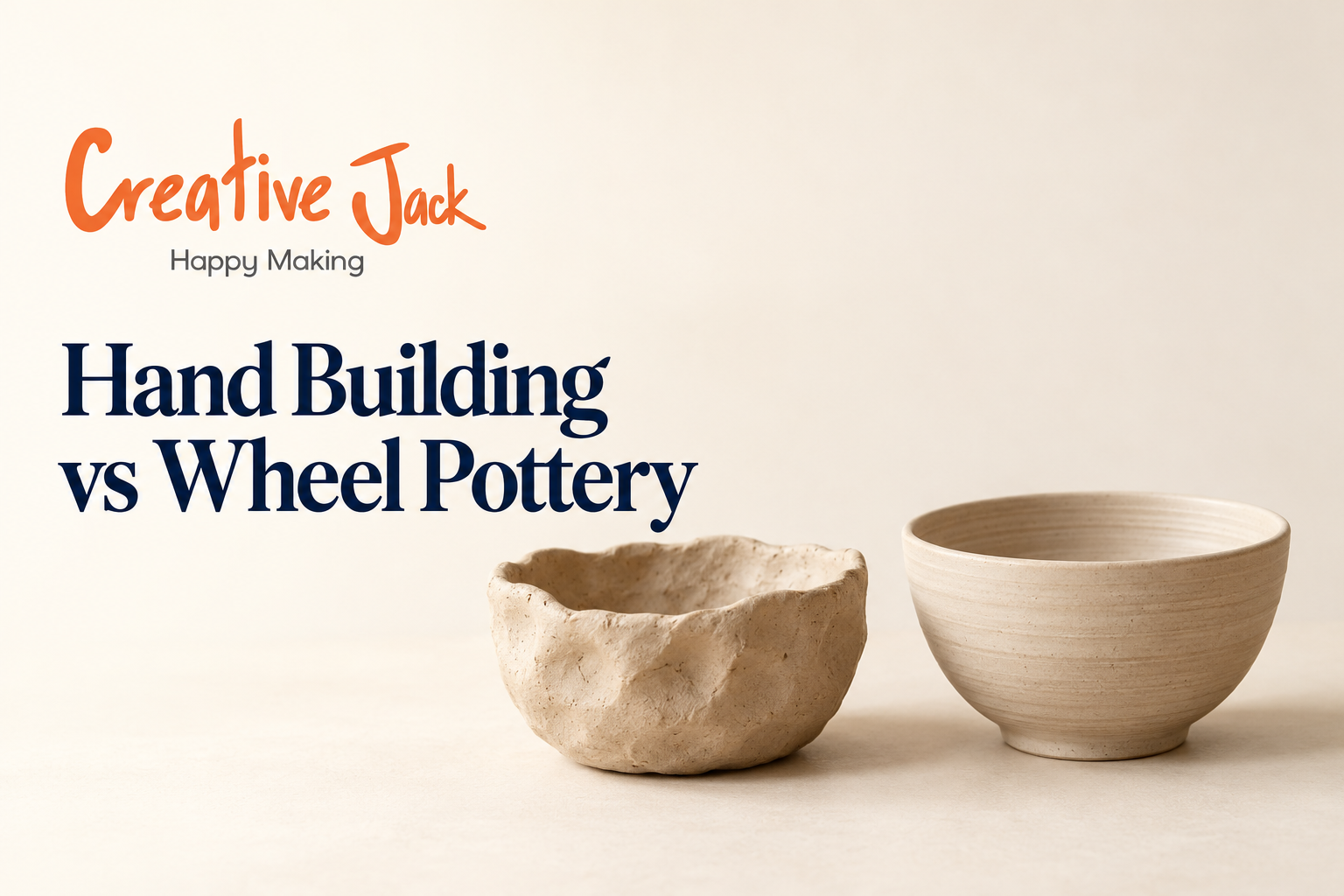
Hand Building vs Wheel Pottery : Which to Start With?
Hand building means shaping clay with your hands and simple tools, using pinch, coil, and slab methods. Wheel pottery means spinning a lump of clay on a wheel and pulling it up into a form. Hand building is easier to start, needs less equipment, and suits sculptural work. Wheel throwing is faster once you have the skill, gives rounder and more even shapes, and takes noticeably longer to learn. For most beginners, starting with hand building is the sensible choice.
What You'll Find in This Article
• How each method actually works
• What each one is good and bad at
• Which is easier on a beginner's patience and budget
• How to choose, and whether you need to choose at all
The Question Beginners Keep Asking
Almost everyone who walks into a pottery studio has the same picture in their head: the wheel, the wet hands, the clay rising up. It is the image from films. So the first thing most people ask is whether they can use the wheel.
It is a fair question, but it skips a bigger one. Do you want to learn the wheel, or do you want to make something with clay? Those are not always the same goal. Before choosing, it helps to understand what each method asks of you.
How Hand Building Works
Hand building covers everything you do without a wheel. There are three main methods.
Pinch. You push your thumb into a ball of clay and pinch the walls outward. Small bowls, cups, and pots come from this.
Coil. You roll ropes of clay and stack them in rings, smoothing the joins as you go. Taller and more irregular shapes work well this way.
Slab. You roll the clay flat and cut shapes to assemble, like working with thick pastry. Boxes, trays, and tiles come from slab work.
Because you can stop, look, and adjust at any point, hand building is slow and easygoing. It rewards patience more than coordination. It is also the natural place to learn how clay behaves, which matters more than people expect.
The Scratch and Slip Habit
One thing that trips up almost every beginner is joining. When you attach a handle, a foot, or a second coil, you need to scratch both surfaces and add slip, which is liquid clay, before pressing them together. Many people call it scratch pottery in casual conversation because of the cross-hatching you make. Skip it and the join looks fine when wet but opens up as the piece dries. Learn this early and you will save yourself a lot of heartbreak.
How Wheel Pottery Works
On the wheel, you place a ball of clay on the wheel head, centre it, open it with your thumbs, and then pull the walls up as the wheel spins. Centring is the part that takes time. If the clay is not perfectly centred, everything that follows wobbles. Even confident beginners can spend several sessions just getting a lump to sit properly in the middle.
When it comes together, though, the wheel is wonderful. You get symmetrical bowls, tall cylinders, and elegant curves much faster than by hand. People who watch pottery masters at work are usually watching decades of muscle memory, and that is why it looks so effortless. Don't judge yourself against it.
Wheel work also asks for more from the studio: a wheel for each student, a kiln for firing, and enough space for splashing water and slip. That is one reason wheel classes tend to be smaller and cost more.
Side-by-Side Comparison
Ease of starting. Hand building is gentler. You can make something decent in your first hour. The wheel often produces frustration in the first few sessions.
Equipment. Hand building needs clay, a table, and basic tools. The wheel needs a wheel, a kiln, and more room.
Types of shapes. Wheel work is best for round, symmetrical forms. Hand building is better for asymmetrical, textured, or sculptural pieces.
Speed. Once learned, the wheel is faster. Hand building takes longer per piece, but you are learning the whole time.
Learning curve. Hand building is gradual. The wheel has a steep early curve and a very rewarding one afterwards.
Cost. Hand building is generally the lower-cost way in.
Where Pottery Meets Sculpture
Hand building sits close to sculpture, and the line between pottery and sculpture blurs quickly. Many studios treat pottery and sculpture as one family because the same material and techniques apply to both. If you want to start with a small animal, a face, or an abstract form instead of a bowl, you are building clay in the same basic way. Pottery sculpture, such as a pot with an animal peeking over the rim, shows the overlap nicely. Clay and sculpture have been partners for thousands of years, and clay in sculpture is usually kept soft while you build, then dried or fired.
For anyone interested in clay sculpture for beginners, simple clay sculptures are a good starting place: a hedgehog from a pinch pot, a leaf-shaped dish, a small bust. They teach structure, proportion, and surface detail without demanding anything technical. If you are new to sculpture for beginners more generally, begin with a form you can see in front of you, like an apple or a shell, and copy what you observe.
Clay Types for Sculpture
The clay you choose changes the experience. Sculpting clay is usually a bit firmer and holds detail better. Terracotta clay sculpture is popular in India because the clay is warm in colour and forgiving, and terracotta sculpture can be left unglazed for a natural look. If you are shopping, you will also see people look for "clay model clay" and end up with modelling clay, which is a soft, oily, non-hardening material closer to plasticine. That is great for sketching ideas and for children, but it is not the same as pottery clay and will not harden into a lasting piece. For a lasting piece, use air-dry or kiln clay.
Basic sculpting techniques are worth learning early: additive building (adding clay), subtractive carving (taking it away), smoothing, and texture work. Most artist clay sculpture combines all four. Creating clay sculptures is mostly a matter of building a sturdy core, adding forms, and refining surface details, often in that order. Clay modelling pottery pieces, where the vessel is shaped by hand rather than thrown, uses the same moves.
Another phrase you will come across is building clay, which usually refers to the coil method or to constructing larger forms in sections. Coarse pottery, meaning clay with grit or grog mixed in, is helpful here because the extra material gives structure to taller or thicker pieces. If your first coil pot slumps, try a grittier clay.
So Which Should You Choose?
For a complete beginner, here is a simple way to decide.
Choose hand building if you want to learn how clay behaves, if you like sculptural or textured work, if you are working on a small budget, or if you want something in your hands in the first hour.
Choose the wheel if you are drawn to round, symmetrical shapes, you can commit to regular practice, and you are comfortable with a slower start.
You do not have to pick for life. Many potters begin with hand building to learn the material, then add the wheel later, and keep using hand building for the pieces that need it.
See It in Action
Watching both methods side by side makes the difference clearer. You can find demonstrations on the Creative Jack YouTube channel, and see student work on our Instagram.
How We Teach It at Creative Jack
Our beginner Pottery Classes course is built around hand building with air-dry and terracotta clay. Students make simple pots and plates, learn how to build stable structures, and add texture and surface detail. We have deliberately kept the focus on hand building because it gives beginners the quickest route to finished work and a solid grasp of clay. If you are specifically looking for wheel throwing, please ask us about it before you enrol, so we can tell you honestly what is on offer. You can also see the Pottery & Sculpting course.
FAQs
Is hand building easier than wheel pottery? For most beginners, yes. You can pause, adjust, and fix as you go, and the early frustration is much lower.
Can I make functional pottery by hand? Yes. Mugs, bowls, and plates are all possible by hand. Functional pieces need proper firing and food-safe glazes.
Do professional potters still hand build? Many do. Plenty of well-known potters use hand building for sculptural forms and handles, even if they throw most of their work.
How long does it take to learn the wheel? It varies, but most people need several sessions just to centre clay reliably, and many months to throw well.
Is hand building a good way to learn sculpture? Yes. The same skills carry directly into clay sculpture, so the two grow together.
Which method is cheaper? Hand building, because it needs fewer tools and less studio equipment.
Hand Building Classes in Mumbai and Pune
If you are in Mumbai, Navi Mumbai, or Pune, our beginner pottery course runs across Art Station studios in Andheri West, Khar West, CBD Belapur, and FC Road. Check the course page for batches near you.
Want to Try It Yourself?
Come and try a hand-building session. book a trial class, or message us on WhatsApp.
Related reads: Pottery for Beginners: Complete Guide | Beginner Pottery Projects | Pottery Tools Every Beginner Needs