



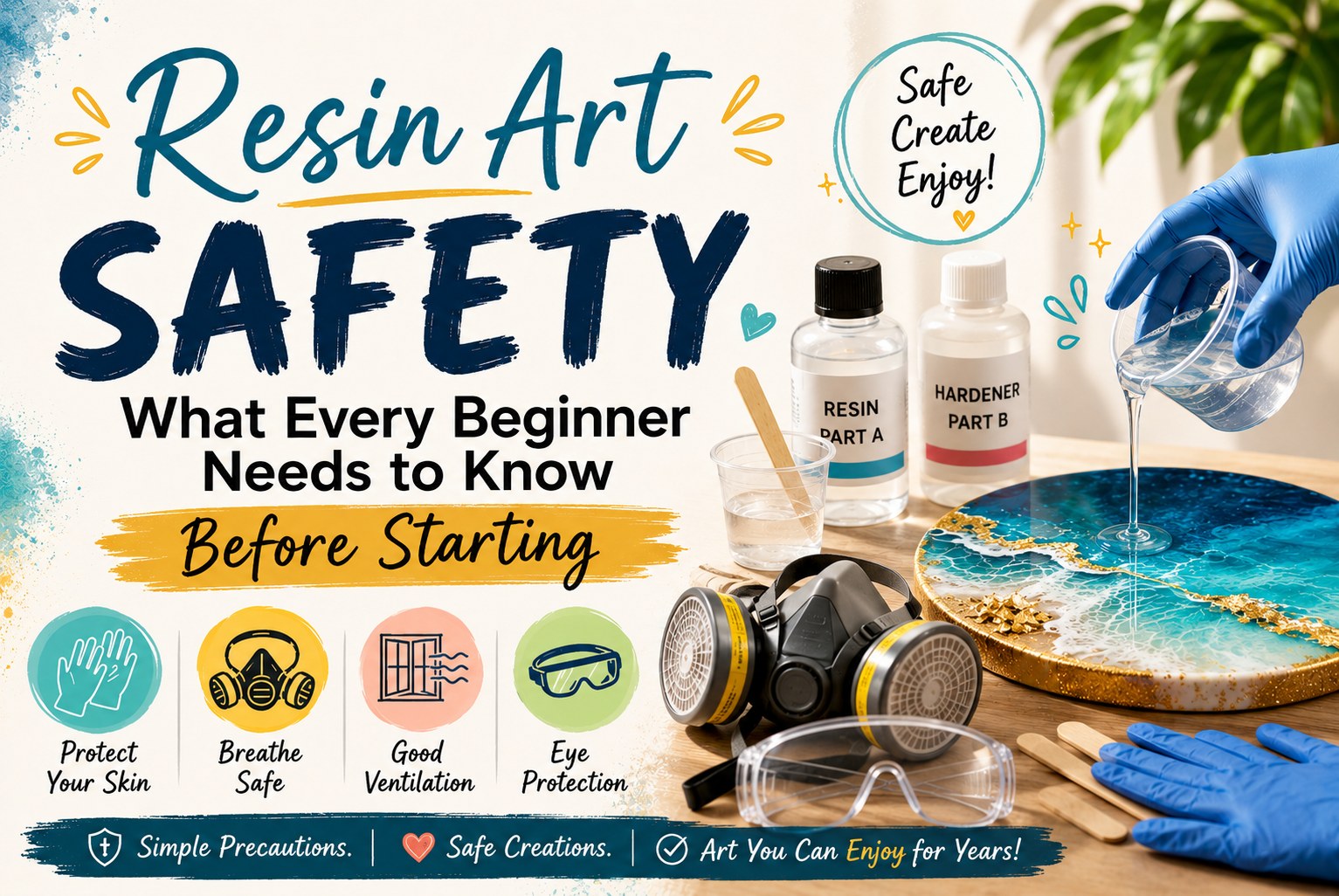
Resin Art Safety: What Every Beginner Needs to Know Before Starting (2026)
Resin art is safe to do at home when you follow the right precautions but it is not risk-free without them. Epoxy resin contains chemicals that require proper ventilation, skin protection, and respiratory protection during every session. The good news is that the safety measures are simple, inexpensive, and once in place, allow you to create without any health concern!
This guide covers everything you need to know about resin art safety before you open your first kit.
This Guide, You'll Learn:
-
Why resin requires safety precautions (the actual chemistry, explained simply)
-
The essential safety equipment you need and why each item matters
-
How to set up a safe workspace at home
-
What to do if resin contacts your skin or eyes
-
Safe disposal of resin waste
-
Red flags that a working environment is not safe enough
Why Beginners Underestimate Resin Safety
Resin art looks clean and glamorous online. The finished pieces are glossy and beautiful. The process looks effortless.
What Instagram doesn't show is that liquid epoxy resin is a reactive chemical and that repeated skin or respiratory exposure without protection can cause sensitisation. Sensitisation is a cumulative reaction: you might work without protection for months with no obvious problem, and then develop a lasting allergic reaction that makes it difficult to work with resin at all in future.
This is the specific reason safety measures with resin are not optional. It's not about dramatic immediate harm but about protecting your long term ability to keep doing something you love.
The other common misconception is that "odourless" resin is safe without a mask. Odour and toxicity are not the same thing. Many low-odour resins still release volatile organic compounds (VOCs) that require respiratory protection.
Step 1: Understand What You're Working With
Uncured vs Cured Resin : What's Actually Dangerous ?
Uncured resin (liquid, before curing is complete) is the health concern. It contains reactive epoxy compounds and amines from the hardener that can cause skin irritation, contact dermatitis, and respiratory sensitisation.
Fully cured resin (solid, after 72 hours of full cure) is inert and safe to handle, display, and use as a functional object. The risk disappears once the chemical reaction is complete.
This means your risk exposure is limited to the period of active work — mixing, pouring, and the first 8–12 hours of curing when the surface is still chemically active. After full cure, the piece is safe.
What resin actually contains:
-
Part A (resin) : Contains bisphenol A diglycidyl ether (BADGE) or similar epoxy compounds
-
Part B (hardener) : Contains amines, which are respiratory and skin irritants
-
Mixed together : Undergo an exothermic (heat-generating) reaction as they cure
None of this is cause for alarm, it's cause for informed, consistent precaution.
Step 2: Set Up Safe Ventilation
Ventilation is the most important element of a safe resin workspace.
Minimum requirements:
-
Work near a fully open window with active airflow and not just a window that's ajar
-
Cross-ventilation is better: a window open on one side of the room, a door or another window open on the other
-
If you have a ceiling fan, use it on low to keep air moving without blowing dust onto wet resin
-
Never work in a completely closed room, a bathroom with the door shut, or any space without active fresh air
In a Mumbai apartment context : Most apartments in Mumbai have limited ventilation options. The best approach is to position your work table directly beside your most ventilated window. For eg : kitchen windows with exhaust fans are often ideal. If your workspace is genuinely poorly ventilated, consider doing your resin pours on a balcony or using a portable fan directed outward from the workspace.
When ventilation alone isn't enough : For large pours (mixing more than 500ml of resin at once), extended work sessions, or small/enclosed spaces, ventilation alone is insufficient. This is when a respirator mask becomes essential rather than just recommended.
Step 3: Resin Art Safety Equipment You Need Every Session
The three items you must wear for every resin session, without exception:
Nitrile Gloves
Nitrile is the correct material, not latex (too porous), not thin vinyl (tears too easily), and definitely not bare hands.
Put gloves on before you open any resin container. Take them off only after you've cleaned up and put all containers away. Resin is colourless. You won't see a splash on your skin until it's already absorbed.
If resin contacts skin despite gloves: wipe immediately with a dry cloth, then wash thoroughly with soap and water. Do not use solvents as they open pores and increase chemical absorption.
Respirator Mask with Organic Vapour Cartridges
A standard dust mask, surgical mask, or N95 respirator does not protect against resin vapours. You need a half-face respirator with organic vapour (OV) cartridges, the same type used for spray painting and chemical work.
Brands to look for in India: 3M 6502, 3M 7502, or equivalent half-face respirators. Available on Amazon India and in hardware and safety equipment stores.
Replace cartridges when you notice any chemical smell through the mask.Tthe cartridges are spent at that point.
Safety Glasses or Goggles
Resin splashes during aggressive stirring. A drop of uncured resin in the eye is a medical concern. Basic safety glasses (₹100–₹300) are sufficient for most home setups.
Step 4: Protect Your Workspace and Clothing
Work surface: Cover everything with a silicone mat or plastic sheeting. Resin bonds permanently to wood, fabric, paper, and most other surfaces. Once cured, it is extremely difficult to remove.
Clothing: Wear clothes you don't mind ruining. Long sleeves protect arms from splashes. An apron adds an extra layer of protection.
Hair: Tie hair back before starting. Resin in hair is very difficult to remove without cutting.
Mumbai specific note: If you're working in monsoon season (June–September), be aware that high humidity (above 75%) can cause "amine blush" — a greasy, waxy film that forms on the surface of curing resin in very humid conditions. Work indoors with a dehumidifier or AC running during high-humidity months for best results.
Step 5: Handle Mixing and Heat Safely
Exothermic reaction, what it means for you :
When resin and hardener are mixed in large quantities, the resulting chemical reaction generates significant heat. This is called an exothermic reaction and is normal, but large quantities of mixed resin can get hot enough to smoke, crack, or in extreme cases, cause a fire.
How to stay safe:
-
Never mix more resin than you need for a single pour
-
If mixed resin in a cup starts to feel hot to the touch, move it away from flammable materials immediately and let it cure safely in a ventilated area
-
Do not mix large quantities of resin in deep, narrow containers — the concentrated heat cannot dissipate and builds up dangerously
-
Use wide, shallow containers for mixing when working with larger volumes
Torch safety: If you use a butane torch for bubble-popping:
-
Keep the torch moving. Never hold it stationary over resin.
-
Maintain at least 8 to 10 cm distance from the resin surface
-
Do not torch near any open solvent containers
-
Store butane canisters away from heat sources
Step 6: Dispose of Resin Waste Safely
Leftover liquid resin: Never pour uncured liquid resin down the drain. It will cure in your pipes or enter the water system in an uncured state.
The safe disposal method: If you have leftover mixed resin in a cup, let it cure completely in a well-ventilated area. Once fully hardened (48–72 hours), it can be disposed of with solid household waste. It is inert once cured.
Contaminated mixing cups and stir sticks: Let any resin residue cure completely before disposal. Don't wash uncured resin down the sink.
Gloves and paper towels with resin residue: Place in a sealed plastic bag and dispose of with regular waste once any resin residue has cured.
Resin containers: Allow any remaining resin inside to cure before disposal. Check your local municipal guidelines for chemical waste disposal if you're disposing of large quantities.
Step 7: First Aid : What to Do If Something Goes Wrong
Resin on skin: Wipe off immediately with a dry cloth or paper towel. Then wash the area with soap and water for several minutes. Do not use solvents or acetone — they open skin pores and increase chemical absorption.
Resin in eyes: Flush immediately with large amounts of clean water for at least 15 minutes. Seek medical attention. Do not rub eyes.
Inhaled fumes (dizziness, headache, nausea): Move to fresh air immediately. If symptoms persist, seek medical attention.
Skin reaction (redness, itching, rash after contact): Consult a dermatologist. Mention that you've been working with epoxy resin. This may be a sensitisation reaction that requires medical assessment.
Learning Resin Art Safely at Creative Jack
One of the significant advantages of learning resin art in a supervised studio environment is that safety is built into the structure. At Creative Jack's Resin Art Course, the studio is set up with proper ventilation, quality safety equipment, and instructor guidance on safe handling from the very first session.
Students who learn safe technique in a structured environment carry those habits into their home practice — rather than learning them only after a problem occurs.
FAQs About Resin Art Safety
Q : Is resin art safe to do at home?
A : Yes, with proper precautions: adequate ventilation, nitrile gloves, and a respirator mask rated for organic vapours. Without these, repeated exposure poses a genuine health risk. With them, resin art is a safe creative practice.
Q :Can I do resin art if I'm pregnant?
A : Most health professionals recommend avoiding working with epoxy resin during pregnancy, as the safety of VOC exposure for foetal development is not fully established. Consult your doctor before continuing or starting resin work during pregnancy.
Q : Is cured resin safe to have in my home?
A : Yes. Once fully cured (48–72 hours), epoxy resin is chemically inert and safe as a household object. The health concern is exclusively during and shortly after the curing process.
Q : Do I need a respirator if I use "odourless" resin?
A : Yes. "Odourless" refers to reduced smell — not the absence of VOCs. Low-odour resins still release vapours that require respiratory protection, particularly in enclosed spaces.
Q : My resin smells very strong — is it safe to use?
A : A very strong smell indicates high VOC content — not necessarily a safety issue with correct PPE, but a signal to ensure excellent ventilation and respiratory protection. Some cheap resins have higher solvent content and produce stronger odours.
Q : Can children do resin art?
A : Resin art is recommended for ages 14 and above due to the chemical handling requirements. At Creative Jack, we have dedicated Kids Art Classes for younger students that use age-appropriate, safe materials.
Want to Learn Resin Art in a Safe, Supervised Environment?
If you're new to resin and want to learn correct technique and safety practice from the start — without the guesswork — Creative Jack's Resin Art Course gives you a fully equipped studio environment with certified instructors who teach safe working as part of the curriculum.
Enrol now → Or chat with us on WhatsApp: +91 83560 65552
Explore More at Creative Jack
Creative Jack is India's Creative Learning Hub. Art and design classes across Mumbai and Pune, for all ages and skill levels.