


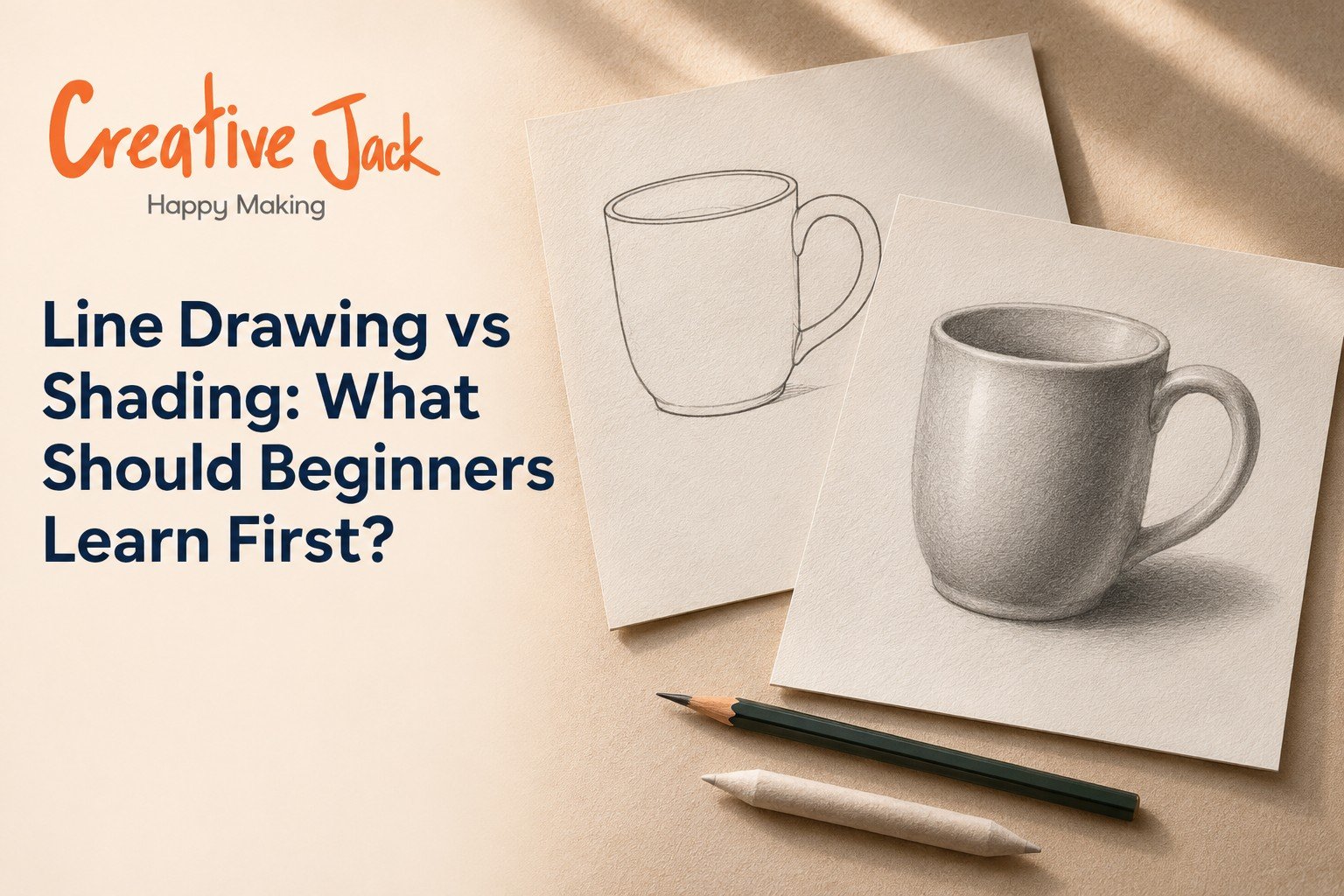
Line Drawing vs Shading: What Should Beginners Learn First?
Beginners should start with line drawing, meaning simple shapes, structure, and proportion, and begin basic shading within the first couple of weeks. Line teaches you how things are built and how big they are in relation to each other. Shading teaches you how they sit in light. You need both, and they help each other, so the best plan is not to finish one before starting the other but to learn line first and add shading early in small, simple steps.
What You'll Find in This Guide
• What line drawing and shading each actually teach
• Why starting with only one of them causes problems
• A step-by-step order that works for most beginners
• How to practise both in the same session
• A four-week plan and the most common mistakes
Why This Question Comes Up
If you are wondering what to learn first in drawing, you are in good company. If you have spent any time looking at beginner drawing advice online, you have seen both camps. One says: learn to draw lines and shapes properly first, and shading will follow. The other says: shading is what makes drawings look real, so start there and the rest will come.
Both are partly right, which is why the question never goes away. The truth is that each skill depends on the other, and the order in which you learn them matters less than how you learn them. Still, there is a sensible sequence that saves most beginners a lot of frustration, and it begins with line.
What Line Drawing Actually Means
Line drawing for beginners is often misunderstood as drawing outlines. In the sense that matters for learning, it covers a wider set of skills.
Line control. Making smooth, confident marks, straight or curved, light or firm.
Shape and structure. Seeing that a bottle is a cylinder, a head is an egg, and a house is a box. Building forms out of simple shapes.
Proportion. Judging how big one part is compared to another.
Contour. Following the edges of a form with your eye and hand together, so that the line describes what you see.
Construction. Using light guide lines to place things on the page before committing.
Notice that none of these is about outlining something in a hard black line. A good line drawing can be very light and loose, and it is mostly about decisions: where things go, how big they are, and how they connect.
What Shading Actually Means
Shading for beginners should start simple. Shading is the use of tone, meaning lighter and darker areas, to describe form and light.
Value. How light or dark an area is.
Light logic. Where the light comes from, and which sides of an object face it, turn away from it, or sit in shadow.
Form. Showing that a shape is round, flat, angled, or bumpy.
Edges. Where tone fades gradually and where it changes suddenly.
Atmosphere. Mood, drama, and depth, which come from the balance of light and dark.
Shading is the difference between a diagram of an apple and a drawing that looks like you could pick it up. If you want to go deeper, our posts on seven shading techniques and making drawings look more realistic explain how.
What Goes Wrong When You Start With Only Shading
Some beginners begin with shading because the results look impressive. They pick a photo, shade it carefully, and end up with a drawing that is smooth and detailed but somehow wrong. The proportions are off, the shapes are lopsided, and no amount of shading can fix it.
Shading cannot rescue a poor structure. Tone sits on top of form, and if the form underneath is wrong, careful shading simply makes the error more visible. It is the equivalent of painting a wall before checking that the wall is straight.
What Goes Wrong When You Start With Only Line
The opposite problem also exists. Some beginners spend months on outlines and never learn tone. Their drawings are accurate and clean, and they look like colouring-book pages. When they eventually try shading, it feels foreign, because they have never practised seeing light.
There is also a motivation problem. Outline drawings can feel unfinished, and many beginners lose heart because their drawings never "pop". A small amount of shading early on keeps people interested.
The Order That Works for Most Beginners
If you want to learn drawing step by step, here is a sequence that balances both, built on the drawing basics for beginners.
Step 1: Line control (days 1 to 3). Practise straight lines, curves, circles, and ellipses. Draw them smoothly and in one stroke. See our guide on how to start drawing as a beginner for a gentle way to do this.
Step 2: Basic forms in line (days 4 to 7). Draw cubes, spheres, cylinders, and cones. Practise seeing everyday objects as combinations of these.
Step 3: Proportion and observation (week 2). Draw simple objects from life, measuring with your pencil. Use light construction lines.
Step 4: A first taste of shading (week 2). Take the same forms from Step 2 and add a single light source. Shade each in three tones: light, medium, dark. Keep it simple.
Step 5: Shading with technique (week 3). Learn two or three methods: hatching, blending, and layered build-up. Practise on a sphere, then on objects.
Step 6: Combine (week 4). Draw a small still life, using line to place and measure, and shading to give form. Move between the two as you work.
The key is to start shading early in a small way, and not to wait for months.
Why They Help Each Other
The two skills are not separate. They feed one another.
Good structure makes shading easier. If you know a bottle is a cylinder, you know how the tone should curve around it. If you only see a collection of outlines, you have nothing to guide your shading.
Shading improves your line. Once you understand where light falls, you start varying your lines: lighter in the lit areas, firmer in the shadows. Line begins to carry weight and depth.
This is why many teachers introduce both together, in short exercises, rather than in separate phases.
Practising Both in One Session
A 30-minute session that mixes them might look like this.
• 5 minutes: Warm up with lines and ellipses.
• 10 minutes: Draw a simple object in line only, focusing on shape and proportion.
• 10 minutes: Add light shading to the same drawing.
• 5 minutes: Step back, squint, and check what you would change.
Doing both on the same drawing makes the link between them obvious.
A Four-Week Starter Plan
Week 1: Line control and basic forms. Fifteen to twenty minutes a day. No shading yet, except one value scale on the last day.
Week 2: Proportion from observation. Add three-tone shading to basic forms.
Week 3: Learn hatching, cross-hatching, and blending. Shade a sphere, a cylinder, and a cube.
Week 4: Draw a small still life of two or three objects, combining both skills.
After the month, look back at your week one drawings. The difference tends to be large.
Common Mistakes
Outlining too heavily. A thick, dark outline flattens a drawing. Use lighter lines, and let tone do the work of defining form.
Shading without checking structure. Make sure the shapes are right before adding tone.
Practising only what is comfortable. If you love shading, force yourself to do line exercises. If you love line, do a few tonal studies a week.
Rushing to detail. Neither skill needs detail to be learned. Simple objects are best.
Comparing yourself with finished artwork. Polished drawings combine years of both skills. Don't judge your month-one work against them.
Where This Matters in Painting and Drawing Courses
This question comes up in almost every art and drawing programme. In most drawing and painting courses, drawing comes first, because the painting & drawing balance is decided by how well you handle line and tone. Many painters start with painting sketching, quick studies in pencil, before they commit to colour. If you are looking for sketching and drawing for beginners material before a painting course, this is why the order matters.
When to Add a Teacher
If you can't tell which skill is holding you back, an outside eye helps. A teacher can look at a drawing and tell you whether it is a structure problem, a tone problem, or both. Our post on common drawing mistakes can help you diagnose it yourself first.
See Both Skills in Action
You can watch simple line and shading demonstrations on the Creative Jack YouTube channel, and browse student drawings on our Instagram.
How Creative Jack Teaches the Two Together
Creative Jack's beginner-level Professional Art Course starts with anatomy sketching and builds towards tonal values and light and shadow, so line and tone are developed side by side. Our beginner-level courses are designed for complete freshers, and classes run online and offline depending on the batch.
FAQs
Should I learn line drawing or shading first? Start with line, meaning shapes and proportion, but introduce simple shading within the first two weeks.
Can I learn shading without good line drawing? You can, but your results will be limited. Shading depends on accurate structure.
Is line drawing easier than shading? It is quicker to get started with, but accurate line drawing takes real practice. Shading takes patience and a good eye for tone.
How long should I practise line before shading? About a week or two of line control and basic forms is plenty before adding simple shading.
Do professional artists use both? Yes. Most drawings combine line for structure and tone for form.
Which is better for sketching? Quick sketches rely mainly on line, with light tone to suggest depth. Finished drawings use more shading.
Is it okay to skip line and do only tonal drawing? Some artists work mostly in tone, but they still need strong structure underneath.
Learning Both in Mumbai, Navi Mumbai, Thane, and Pune
If you want a teacher to guide both skills, our Professional Art Course is listed at Art Station Andheri West, Khar West, CBD Belapur, and FC Road Pune, and at Mango Stationery in Thane West. Check the course page for batches near you.
Not Sure Which to Work On?
Book a free trial class or message us on WhatsApp, and bring a few drawings.
Related reads: How to Improve Your Pencil Shading and Make Drawings Look More Realistic | Complete Beginner's Guide to Drawing | 10 Drawing Exercises to Improve Your Sketching Skills Faster