


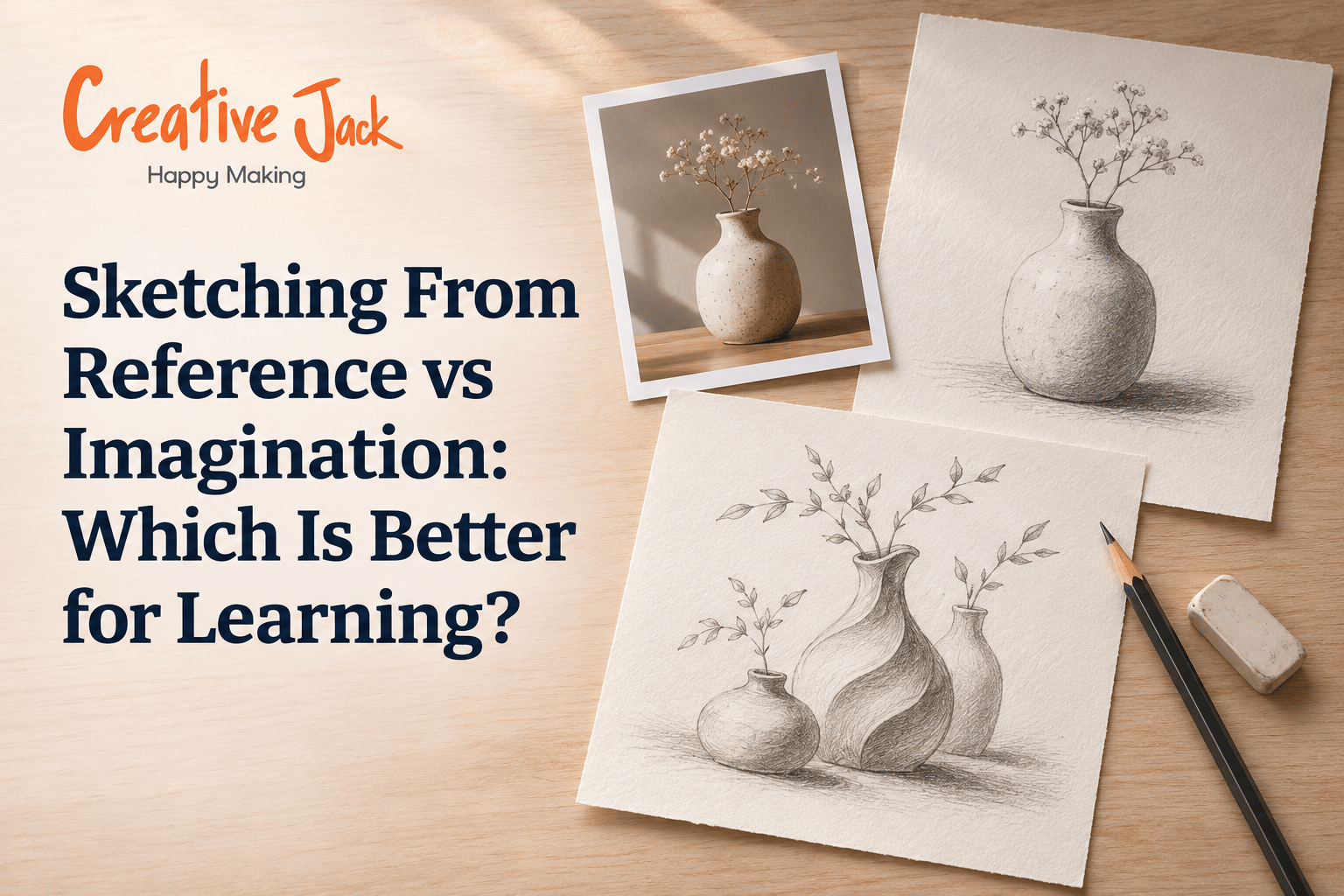
Sketching From Reference vs Imagination: Which Is Better for Learning?
For learning, sketching from reference is better in the early months, and imagination becomes more useful once you have a stock of observed knowledge to draw on. Reference teaches you what things really look like. Imagination tests whether you remember it and lets you invent. Most artists who improve quickly use both, starting with something like 80 percent reference and 20 percent imagination, and shifting the balance as their skills grow.
What You'll Find in This Guide
• What each approach is, and what each one trains
• Why drawing only from imagination often stalls beginners
• Why drawing only from reference can also hold you back
• A practical way to combine them
• How to use reference honestly and legally
• A simple weekly split
Why This Debate Never Ends
Ask a group of artists and you will hear strong opinions. Some say reference is the only way to learn, because your imagination can only produce what you already know. Others say relying on reference makes your work stiff and copy-like, and that the real skill is drawing without it.
Both sides are seeing something real, and the same argument runs through painting sketching and wider art and drawing courses. They are describing different stages and different goals. A beginner and an experienced illustrator need different things, and the best approach changes as you improve.
What Drawing From Reference Means
The question of drawing from reference vs imagination is really a question about how to learn drawing in a sensible order.
Reference is anything real you look at while you draw: an object in front of you, a person posing, a photo, a book, or a screen. It falls into two main types.
Drawing from life. You observe a real subject in three dimensions. You see depth, real light, and subtle colour shifts, and you decide what to include.
Drawing from photos or images. Drawing from life vs photos is the most useful distinction here. The subject is already flattened. It is easier to copy because it does not move, and the light stays the same, but you lose some of the depth and some of the decision-making.
Both train observation, and observational drawing is the core skill of the whole craft. When you look hard at something and try to record it, your eye and hand learn to work together.
What Drawing From Imagination Means
Imagination, sometimes called drawing from memory or from your head, means drawing without a visible model. You might invent a character, a creature, a landscape, or an object that does not exist.
It trains a different set of skills: recalling what things look like, constructing forms in three dimensions in your mind, designing, and making choices. It is also much more fun for many people, which matters, because the drawing you enjoy is the drawing you keep doing.
Why Only Imagination Often Stalls Beginners
Drawing from imagination feels freeing, but it has a hidden requirement: you can only draw what you know. If you have never carefully observed how a hand is built, your imagined hands will repeat the same simplified shapes, and they will look wrong in the same ways every time.
This is why many beginners who draw only from imagination plateau. Their drawings look the same year after year, because they keep reinforcing the same mental shortcuts. They are drawing symbols from memory, and the symbols never improve because they are never checked against reality.
In effect, imagination draws on a library of visual knowledge. Reference is how you stock the library.
Why Only Reference Can Also Hold You Back
Reference-only practice has its own trap. If you always copy a photo, you can end up as a good copier and a poor designer. You may struggle to draw anything that is not in front of you, or to change a pose, or to simplify.
Copying photos can also teach bad habits. A camera flattens depth, exaggerates perspective on close subjects, and records detail that the eye normally ignores. If you copy it line for line, your drawing can inherit those distortions and look like a drawing of a photo, not a drawing of a thing.
Finally, there is a motivation issue. Some people find pure copying tedious and drop drawing altogether.
What Each Approach Trains
Skill
Reference
Imagination
Observation
Strong
Weak
Proportion accuracy
Strong
Moderate
Light and shadow
Strong
Moderate
Memory
Weak
Strong
Invention and design
Weak
Strong
Confidence with form
Strong
Strong
You can see from the table that they complement each other.
The Best Approach: A Loop
The most effective method is a loop that uses both.
Step 1: Study from reference. Draw an object or figure from life or a good photo. Take your time. Measure and compare.
Step 2: Draw it from memory. Put the reference away and draw the same thing again from memory. Notice what you remember and what you forgot.
Step 3: Check. Bring the reference back and compare. Where did you go wrong? Note it.
Step 4: Vary it. Draw the same object from a different angle, in a different pose, or in a different size, without reference. This is imagination, but now it is grounded in what you just studied.
Step 5: Repeat. Return to reference to correct your new drawing.
Over time, this builds your visual library and trains you to use it. If you want a related exercise, the "memory drawing" drill in our post on 10 drawing exercises to improve your sketching skills faster is a good starting point.
How the Balance Should Shift
Months 1 to 3. Mostly reference, around 80 percent or more. Draw simple objects from life. The goal is to build observation and structure.
Months 3 to 6. Increase imagination to perhaps 30 percent. Use memory drawing and variations after each study.
Months 6 to 12. A fairly even mix. Use reference to solve specific problems, such as hands or perspective, and imagination to design.
After a year. You choose, depending on your goals. Illustrators and concept designers lean towards imagination backed by reference libraries. Portrait and realism artists lean towards reference.
These ratios are guidelines, not rules. If you are more motivated by imagination, adjust the split but keep some regular observation.
Practical Ways to Use Reference Well
Draw from life whenever you can. Even a mug on your desk is better than a photo for learning depth and light.
Use good photos. Using reference photos for drawing works best when you look for clear lighting and sharp focus. Avoid heavily filtered images.
Take your own photos. Photograph your own objects, friends, or surroundings. You get reference that is yours and fits what you want to draw.
Use multiple references. For a pose or an object, look at several images so you do not copy one photo exactly.
Simplify. Do not copy every detail. Decide what matters.
Look away. Glance at the reference, then draw, then glance again. Do not trace your eyes along the photo constantly.
Check with a mirror or a flip. Compare your drawing to the reference after you finish.
Using Reference Honestly
If you are drawing for yourself, practising, you can use any photo. If you plan to share or sell your work, be careful.
Do not trace someone else's photograph or artwork and present it as your own. Tracing is fine for private practice, but publishing a traced copy without permission can be copyright infringement and is generally seen as dishonest.
Credit your sources. If you post a drawing of someone else's photo, credit the photographer.
Use free or licensed images. Sites with images that allow reuse are a good source for practice references.
Take your own where possible. It avoids the question altogether.
A Simple Weekly Split
Here is a weekly plan that mixes both approaches.
• Monday: Reference study from life, 20 minutes, such as a mug or a plant.
• Tuesday: Same object from memory, 10 minutes, and then a check.
• Wednesday: Reference study of a different subject, maybe a hand.
• Thursday: Draw the same subject from another angle without reference.
• Friday: Free sketching from imagination, 15 minutes. Make something up.
• Weekend: One longer drawing, mixing both. Use reference for tricky parts, imagination for the rest.
When a Teacher Helps
A teacher helps you see what you are missing from reference, and gives feedback on your imaginative work, which is harder to judge yourself. If you are considering a class, our posts on drawing classes for adults and sketching classes in Mumbai explain what to look for.
See Both in Practice
You can watch studies and imaginative sketching on the Creative Jack YouTube channel, and see student work on our Instagram.
How Creative Jack Approaches It
Creative Jack's beginner-level Professional Art Course starts with anatomy sketching and observation, building the visual knowledge that later supports freer, more imaginative work. Our beginner-level courses are designed for complete freshers, with classes online and offline depending on the batch.
FAQs
Is it cheating to draw from reference? No. Almost every artist uses reference. It is how you learn to see accurately.
Can I learn to draw only from imagination? You can, but progress is slower, because you can only draw what you already know. Mix in observation.
Is drawing from life better than from photos? For learning depth and light, yes. Photos are fine for convenience and for subjects you cannot place in front of you.
How do I get better at drawing from memory? Study something, draw it from memory, compare, and repeat. Visual memory improves with practice.
Is tracing a good way to learn? It can help you understand shapes, but it does not train observation. Don't rely on it and don't publish traced work as your own.
What should beginners focus on? Mostly reference, with a little memory drawing after each study.
When should I move to imagination? Once you can draw simple forms accurately from life, start adding imaginative drawings gradually.
Sketching Classes in Mumbai, Navi Mumbai, Thane, and Pune
If you would like a teacher to guide this balance, our Professional Art Course is listed at Art Station Andheri West, Khar West, CBD Belapur, and FC Road Pune, and at Mango Stationery in Thane West.
Want to Build Both Skills?
Book a free trial class or message us on WhatsApp.
Related reads: 10 Drawing Exercises to Improve Your Sketching Skills Faster | How to Build a Daily Drawing Practice Without Feeling Overwhelmed | Complete Beginner's Guide to Drawing