



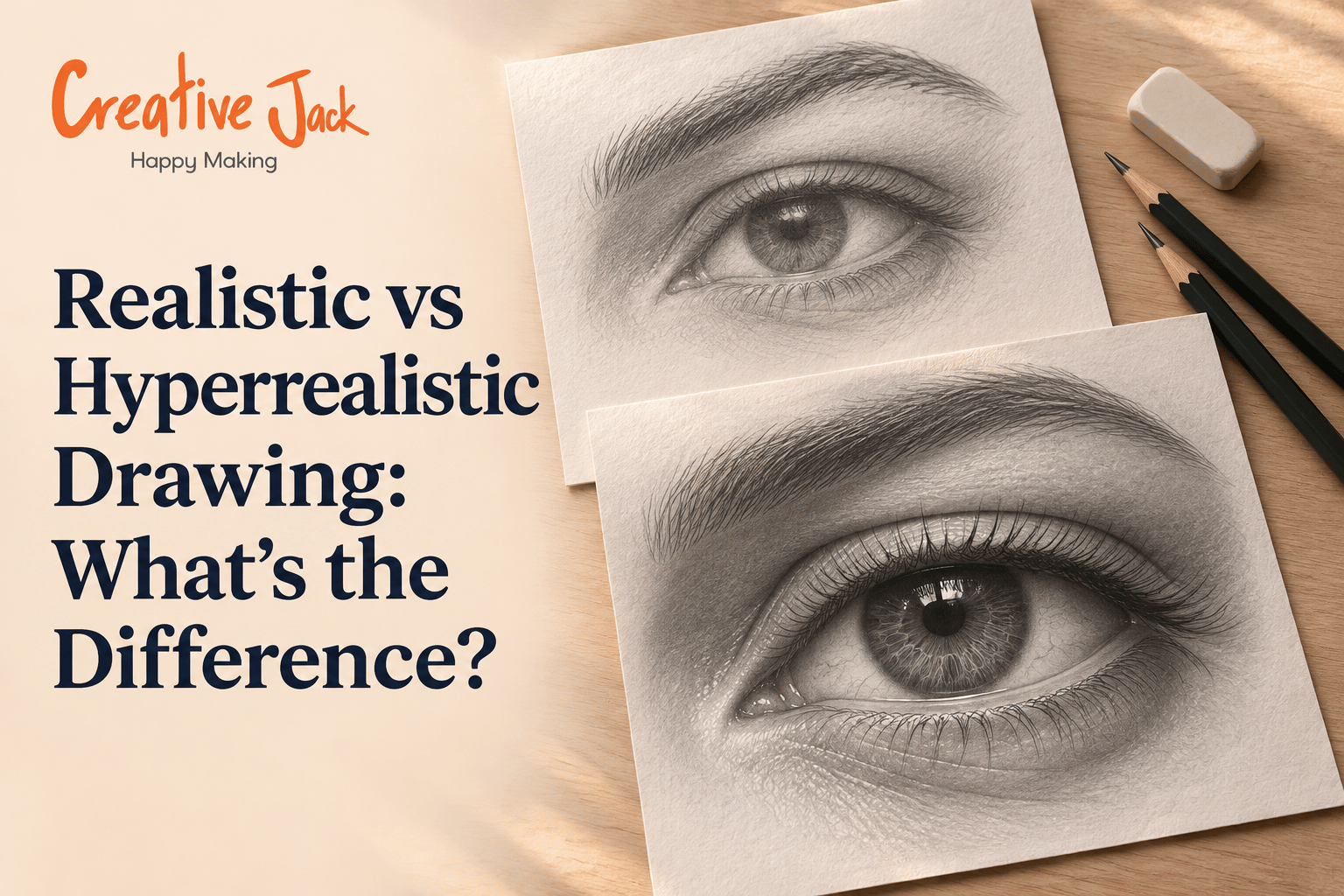
Realistic vs Hyperrealistic Drawing: What's the Difference?
Realistic drawing aims to make a subject look convincing and true to life, using accurate proportion, believable light, and selective detail, while still letting the hand of the artist show. Hyperrealistic drawing goes further. It aims to look as sharp as, or sharper than, a high-resolution photograph, with extreme control of tone, texture, and fine detail, and it usually takes far longer to make. Realism is a skill most artists can build in months. Hyperrealism is a specialised practice built on top of it.
What You'll Find in This Guide
• Clear definitions of realism, photorealism, and hyperrealism
• A side-by-side comparison on detail, time, tools, and purpose
• How each style is made, step by step
• Which one beginners should aim for, and in what order
• The honest challenges of hyperrealism
• A short path from realism towards hyperrealistic work, if you want it
Why the Terms Get Confused
You will see these words used loosely. A pencil portrait that looks like a photo gets called "hyperrealistic" on social media, even when it is simply good realism. A loosely drawn but accurate still life gets called "photorealistic". The labels slip because the line between them is a matter of degree, and because online, impressive drawings attract strong words.
It is still worth knowing the difference. The goals, methods, and time commitment are different, and choosing the wrong target can leave a beginner frustrated.
Definitions
Realistic Drawing
A realistic drawing represents its subject faithfully. Proportions are accurate, light and shadow are convincing, and the subject looks solid and real. But there is room for interpretation. The artist chooses what to emphasise and what to simplify, and the marks of the hand, such as hatching or blended tone, can remain visible. A realistic drawing can look like a person, a fruit, or a street, without looking like a photograph of it.
Photorealism
Photorealism is an art movement that emerged in the late 1960s, in which artists, working mainly in paint, reproduced photographs with great precision. The goal was to make the finished work look like a photograph, and the photograph was often the direct source. The term is now used more broadly for any work that looks like a photograph.
Hyperrealism
Hyperrealism is a later development. It builds on photorealism but typically goes beyond what a camera records, often by exaggerating detail, texture, and emotion, or by depicting subjects at a scale or in a way a photo would not. Hyperrealist drawings may show pores, individual hairs, water droplets, and reflections with extreme clarity, and they often aim to evoke a feeling as well as a likeness.
In everyday use, "hyperrealistic drawing" simply means a drawing that looks like, or looks sharper than, a very detailed photograph.
Side-by-Side Comparison
Aspect
Realistic
Hyperrealistic
Goal
Convincing likeness and form
Photograph-like or beyond-photograph detail
Detail
Selective, suggested
Extreme, everywhere
Visible hand
Often visible
Usually hidden
Source
Life or photo
Almost always a high-resolution photo
Time
Minutes to a few hours
Many hours, often tens or hundreds
Tools
A range of pencils, charcoal
Wide range of grades, fine blending tools, often large paper
Skill demand
Strong observation, tone, and proportion
All of that, plus patience and precision
Typical subjects
Anything
Portraits, eyes, water, glass, metal, fruit
Beginner-friendly
Yes
Not as a first target
How a Realistic Drawing Is Made
A realistic drawing follows the process most beginners learn.
1. Plan the composition. Thumbnails and a focal point. See our guide to improving composition.
2. Measure and block in. Observational drawing. See observational drawing.
3. Map the values. Large shapes of light and dark.
4. Build tone in layers. With a range of pencils or charcoal.
5. Control edges. Hard, soft, and lost.
6. Add selective detail. Where the eye lands, not everywhere.
7. Step back and adjust.
The result looks convincing at normal viewing distance, and the viewer enjoys the artist's choices.
How a Hyperrealistic Drawing Is Made
Hyperrealism uses the same foundations, with stricter control.
1. A high-resolution reference. Most hyperrealists work from large, sharp photographs, often printed or displayed on a screen, because no live subject holds still long enough. They need every pore and highlight visible.
2. Accurate transfer. The outline is often placed using a grid, careful measurement, or a light transfer, because the proportions must be exact. This is a training and precision tool, not a shortcut for skills you lack.
3. Working in small sections. The artist completes one small area at a time, often from top to bottom, to avoid smudging. Each area is brought to a high finish before moving on.
4. Many layers of tone. Dozens of thin layers of graphite or charcoal, with fine blending, build smooth gradients and deep darks.
5. A wide range of pencil grades. From hard pencils for fine, light detail to very soft ones for the deepest darks.
6. Fine lifting and highlights. Precision erasers, such as a fine-tipped eraser or an eraser pencil, pick out highlights and fine hairs.
7. Constant comparison. The drawing is checked against the reference in detail, area by area.
8. Protecting the surface. A clean sheet under the hand, gloves, and careful handling stop smudges and oils.
A hyperrealistic drawing can take many days or weeks, depending on size and detail.
What Hyperrealism Demands
Time. Hours and hours. A face drawn at large scale in hyperrealistic detail commonly takes many sessions.
Patience. It requires working slowly, with a steady hand, on one small area at a time.
Precision. Small errors in proportion or tone are obvious at this level of finish.
Technical control. Smooth gradients, consistent pressure, and clean edges.
Good materials. Quality paper that tolerates layers and erasing, and a wide range of pencils.
A good eye for detail. You must notice the tiny things that a camera records.
It is a worthwhile pursuit, but it is a particular one. Some artists love it. Others find it joyless, and prefer a looser style.
Which One Should a Beginner Aim For?
Realism first. There are several reasons.
Hyperrealism depends on realism. A hyperrealistic drawing is a realistic drawing with extreme finish. If proportion and tone are weak, no amount of detail rescues it.
Realism teaches you to see. The habits of measuring, checking, and mapping values are the base for any realistic work.
Realism is faster to learn from. You make more drawings, and so make more mistakes, and learn more quickly.
Hyperrealism can create bad habits for beginners. Fussing over small details too early encourages tight, timid drawing. And working from photos only means you may never learn to observe from life.
Realism is more flexible. It allows interpretation, speed, and expression.
If you are drawn to hyperrealism, you do not have to abandon the goal. Treat it as a later stage. Many hyperrealists spent years on realistic drawing first.
A Path From Realism Towards Hyperrealism
If you want to move in that direction, here is a sensible order.
Stage 1: Foundations (months 1 to 6). Learn proportion, observation, and basic shading. See our guides to how to start drawing and pencil shading.
Stage 2: Convincing realism (months 6 to 18). Draw still lifes, portraits, and textures from life and photos. Aim for believable values and edges.
Stage 3: Refined detail (a year or more). Work from high-quality references. Practise on smaller subjects, such as an eye, a hand, a glass of water, or a piece of fruit. Practise smooth gradients and layered shading.
Stage 4: Hyperreal finish. Take on larger, more complex pieces, and learn to sustain patience over many sessions.
This is a rough path. Everyone's pace is different, and some people choose to stay at realism.
Realism and Hyperrealism in Portraits
Portraits are the most common subject for both. Realistic portraits aim for likeness and character, often with loose, expressive areas. Hyperrealistic portraits show each pore, hair, and reflection in the eye. For realistic work, see our guides to portrait sketching techniques and facial proportions.
A Note on Using Photographs Honestly
Hyperrealism almost always relies on photos. Be careful about whose photographs you use.
• Use your own photographs, or images that are licensed for reuse.
• If you work from someone else's photograph, get permission before sharing or selling the drawing.
• Credit your sources.
• Do not present a close copy of someone else's work as your own.
These habits protect both you and the people whose work you admire.
Common Misconceptions
"If it does not look like a photo, it is not good." Many of the most admired drawings in history look nothing like photographs.
"Hyperrealism is the highest level of drawing." It is one style, with its own demands. Looser, expressive drawing is just as hard to do well.
"You need a special talent." You need practice, patience, and good habits.
"It is just tracing." Some use transfer methods, but the tonal work is still demanding. Treat claims carefully, and judge by the drawing and the artist's openness about their process.
Which Is Right for You?
Ask yourself:
• Do I enjoy slow, detailed work, or quick, expressive drawing?
• How much time can I give to one drawing?
• Do I like working from life or from photos?
• Am I drawn to a photographic finish, or do I want my hand to show?
There is no wrong answer. But knowing the difference helps you choose how to practise.
See Realism Taking Shape
Watching a realistic drawing develop, layer by layer, is the best way to understand it. You can find demonstrations on the Creative Jack YouTube channel, and see student work on our Instagram.
How Creative Jack Teaches Realism
Creative Jack's Pencil Drawing course focuses on realism portraits, listed under the Pencil Drawing category. Please check the course listing for current levels and batches, or message us. The beginner-level Professional Art Course also covers charcoal portraits, still life, tonal values, and light and shadow. If you are looking at pencil drawing classes near me or portrait drawing courses with a realism focus, ask about the level and what you will be able to draw by the end. We do not promise hyperrealistic results, and we are happy to tell you honestly what a course will and will not cover. We offer online and offline classes depending on the batch.
FAQs
What is the difference between realistic and hyperrealistic drawing? Realistic drawing looks convincing and true to life, with selective detail. Hyperrealistic drawing aims for photograph-like or sharper detail everywhere.
Is photorealism the same as hyperrealism? They are related. Photorealism copies photographs closely, and hyperrealism often goes further in detail and emotion.
How long does a hyperrealistic drawing take? Many hours, often tens or hundreds, depending on size and detail.
Can beginners draw hyperrealistically? Not as a first step. Build realism skills first.
Do hyperrealists trace? Some use grids or transfer for the outline, then do all the tonal work by hand. Methods vary.
What materials are used? A wide range of graphite pencils, good paper, fine blending tools, and precision erasers.
Should I learn realism or hyperrealism first? Realism. Hyperrealism is built on it.
Learning Realism in Mumbai, Navi Mumbai, Thane, and Pune
If you would like a teacher to guide your realism, our Professional Art Course is listed at Art Station Andheri West, Khar West, CBD Belapur, and FC Road Pune, and at Mango Stationery in Thane West. Ask about Pencil Drawing batches too.
Want to Build a Realistic Foundation?
Book a free trial class or message us on WhatsApp.
Related reads: Observational Drawing | Portrait Sketching Techniques for More Realistic Faces | How to Improve Your Pencil Shading and Make Drawings Look More Realistic